
"Power tends to corrupt, and absolute power corrupts absolutely."
— Lord Acton, 1887
"The question of what values to embed in military AI is too important to be resolved by a Cold War-era production statute."
— Prof. Alan Rozenshtein, Lawfare, February 2026
PROLOGUE: A FRIDAY THAT CHANGED EVERYTHING
On the afternoon of February 27, 2026, the President of the United States took to social media and issued an order that will reverberate through the halls of American law, technology, and democratic governance for decades to come. Every federal agency was directed to immediately cease use of Anthropic's artificial intelligence. The Pentagon's Secretary of War designated the company—an American firm, headquartered in San Francisco, staffed by American citizens—a "supply chain risk to national security." A label historically reserved for Huawei. For Kaspersky. For the agents of foreign adversaries.
Anthropic's offense? It refused to let its AI be used for mass domestic surveillance of American citizens or to power fully autonomous weapons that kill without a human in the loop. That's it. Two red lines. Two commitments so modest that OpenAI's Sam Altman publicly declared he shared them, and then quietly built them into his own Pentagon deal hours later.
This is not a story about a contract dispute. This is the story of the first great test of whether democratic values will govern the most powerful technology humanity has ever built—or whether that technology will be seized by unchecked executive authority and wielded in the dark. If that sounds dramatic, consider: we are watching, in real time, a government use the machinery of national security law to punish a private company for insisting on constitutional guardrails. And the precedent being set will not be contained to one company, one technology, or one administration.
This is your fight too. Every one of you. Here's why.
PART I: THE TWO POINTS OF CONTENTION
The entire Anthropic-Pentagon showdown rests on two narrow provisions that Anthropic has maintained since it first began serving the Department of Defense in 2024. They are simple enough to state in a sentence each, and profound enough to reshape the constitutional landscape of America.
Contention One: Mass Domestic Surveillance
Anthropic insists that its AI model, Claude, must not be used for mass surveillance of American citizens. Not targeted surveillance pursuant to a warrant. Not intelligence-gathering abroad against foreign threats. Mass domestic surveillance—the wholesale monitoring of the American people by their own military.
The Pentagon's response is that it has no interest in such surveillance and that it would be illegal under existing law. If that is true, then writing it into a contract should cost nothing. The fact that the Department of War fought so bitterly against explicit language tells you something important about the gap between what officials say publicly and what they want the legal freedom to do behind classified walls.
Anthropic CEO Dario Amodei has articulated the fear with precision: an advanced AI given access to enough data could "make a mockery of the Fourth Amendment." And he is right. The Fourth Amendment was written when surveillance meant a king's agents physically entering your home. Today's surveillance law was written before AI could analyze millions of communications simultaneously, correlate patterns across billions of data points, and build comprehensive profiles of citizens who have committed no crime and are suspected of nothing.
The phrase "all lawful purposes" sounds reasonable until you realize how much territory "lawful" now covers. As Professor Rozenshtein of the University of Minnesota Law School has observed, existing surveillance law was drafted long before the capabilities that frontier AI models now provide. "Lawful" does not mean "ethical." It does not mean "consistent with constitutional values." It means "not yet prohibited by statute," and in the realm of AI-assisted surveillance, almost nothing has been prohibited because almost nothing has been legislated.
Consider for a moment what a tool like Claude could do with access to military and intelligence databases. It could correlate your phone's location data with your social media activity, your financial transactions, your medical records, your reading habits, your associations. Not because you are suspected of anything. Because the system has no inherent concept of suspicion—only patterns. The line between "intelligence analysis" and "totalitarian surveillance" becomes invisible when the tool is powerful enough to erase it.
That is what Anthropic was trying to prevent. Not AI in defense. Not AI in national security. AI as a tool of unaccountable mass observation of free citizens. And for this, it was branded a national security threat.
Contention Two: Fully Autonomous Weapons
The second red line is equally stark. Anthropic insists that Claude not be deployed in weapons systems that select and engage targets without human authorization. Not AI-assisted targeting. Not computer-aided decision support. Fully autonomous lethal systems—machines that decide, on their own, who lives and who dies.
"The constitutional protections in our military structures depend on the idea that there are humans who would disobey illegal orders. With fully autonomous weapons, there is no one to disobey."
— Dario Amodei, CEO, Anthropic
This is not a hypothetical concern dreamed up by philosophers. The Washington Post reported on a classified Pentagon scenario exercise involving a hypothetical nuclear escalation that apparently catalyzed this very dispute. AI models hallucinate. They confabulate. They make confident errors that no human operator would tolerate. Current frontier models, for all their extraordinary capabilities, are not reliable enough to make life-and-death decisions in the fog of war, where a misclassification does not mean a wrong answer on a test but a dead civilian in a village, a shot-down allied aircraft, or a catastrophic escalation.
Anthropic's position on autonomous weapons is not an anti-military position. It is a pro-human position. It says that before we hand the most consequential decision a government can make—the decision to take human life—to an algorithm, we should have legislative frameworks, tested reliability standards, and democratic consensus. Not a contract clause negotiated behind closed doors between a defense secretary and a CEO.
PART II: THE SUPPLY CHAIN RISK DESIGNATION
Law, Overreach, and the Path to Court
What the Law Actually Says
The Pentagon's nuclear option against Anthropic—the "supply chain risk" designation—invokes 10 U.S.C. § 3252 and the Federal Acquisition Supply Chain Security Act (FASCSA). These statutes were enacted to protect the American defense industrial base from foreign adversaries who might embed malware, backdoors, or sabotage mechanisms into the technology supply chain. The statute defines "supply chain risk" as:
STATUTORY DEFINITION — "Supply Chain Risk"
"The risk that an adversary may sabotage, maliciously introduce unwanted function, or otherwise subvert the design, integrity, manufacturing, production, distribution, installation, operation, or maintenance of a covered system so as to surveil, deny, disrupt, or otherwise degrade the function, use, or operation of such system."
Read those words carefully. Sabotage. Malicious introduction. Subversion. Adversary. Every one of these terms contemplates a hostile act by an enemy of the United States—not a contractual use restriction by an American company that is openly, transparently, and in good faith negotiating the terms under which it provides its product.
The only time a FASCSA order has ever been issued was against Acronis AG, a Swiss cybersecurity firm with documented ties to Russian intelligence. Anthropic is not Acronis. It is not Huawei. It is an American public benefit corporation that was the first frontier AI lab to deploy on classified Pentagon networks, whose technology was reportedly used in the military operation to apprehend Venezuelan President Nicolás Maduro. This is the company being labeled a supply chain risk—not for what it did, but for what it wouldn't agree to.
The Procedural Failures
The legal vulnerabilities in the Pentagon's designation are not merely theoretical. They are structural, procedural, and devastating. Multiple independent legal scholars have already identified at least four fatal deficiencies.
1. No Formal Risk Assessment
Under 10 U.S.C. § 3252(b), the designation requires a risk assessment documenting that there is a "significant supply chain risk to a covered system." Charlie Bullock, Senior Research Fellow at the Institute for Law & AI, has publicly stated that it is unclear whether the government conducted any such assessment. A designation without one is procedurally void.
2. No Congressional Notification
Section 3252(b)(3) requires that the Pentagon provide a "classified or unclassified notice" to the appropriate congressional committees before acting, including "a summary of the risk assessment" and "a discussion of less intrusive measures that were considered and why they were not reasonably available." There is no public indication that Congress was notified. Multiple members of the relevant committees have publicly demanded information, suggesting they were blindsided.
3. No Exhaustion of Alternatives
The law explicitly demands a showing that less intrusive measures were considered and found inadequate. The Pentagon's own officials acknowledged that the obvious less intrusive measure—simply finding a different AI vendor—was available and that multiple competitors were willing to serve on the Pentagon's terms. When you can simply switch vendors, designating the vendor you're leaving as a supply chain risk is not a security measure; it is a punishment.
4. No Adversary
As Amos Toh of the Brennan Center for Justice at NYU has stated: the supply chain risk designation requires the government to demonstrate that an adversary could exploit the identified risk to sabotage, subvert, or manipulate military operations. "It is not at all clear how adversaries could exploit Anthropic's usage restrictions on Claude to sabotage military systems." A company saying "we won't let you use our product for mass surveillance" does not create a vector for foreign sabotage. It creates a contractual limitation. These are categorically different things.
The Inherent Contradiction
Perhaps the most devastating argument Anthropic can bring to court is the government's own internal contradiction. Earlier in the same week, the Pentagon threatened to invoke the Defense Production Act to compel Anthropic to provide its technology—an authority premised on the idea that the product is so vital to national defense that the government cannot function without it. Days later, the same Pentagon designated the same company a supply chain risk—premised on the idea that the product is so dangerous it must be purged from the defense industrial base entirely.
The government cannot simultaneously argue that Anthropic's technology is so critical to national security that it must be commandeered under wartime powers, and so toxic to national security that every defense contractor must be forbidden from touching it. These are mutually exclusive propositions. A court reviewing this designation will see that immediately.
— Mark Dalton, R Street Institute
Anthropic's Path to Victory
Anthropic has publicly stated it will challenge the supply chain risk designation in court. Based on the legal landscape as of today, its path to victory is strong and proceeds along several reinforcing axes.
Statutory Challenge (10 U.S.C. § 3252 / FASCSA)
Anthropic will argue that the designation fails to meet any of the statute's substantive requirements. There is no adversary. There is no sabotage or subversion. There is no completed risk assessment. There was no Congressional notification. And less intrusive alternatives were not only available but obvious—the Pentagon could simply have terminated the contract and moved to another vendor, which is precisely what it did by signing with OpenAI hours later.
Scope Limitation
Even if the designation is upheld in some narrow form, Anthropic will argue—correctly, based on the statute's text—that the Secretary does not have the authority to prohibit all commercial activity between defense contractors and Anthropic. The statute governs procurement for covered systems. It cannot, as Anthropic has stated, "affect how contractors use Claude to serve other customers." Hegseth's sweeping declaration that no defense contractor may "conduct any commercial activity with Anthropic" goes far beyond what the statute authorizes.
First Amendment / Compelled Speech
This is the constitutional frontier. If the government invokes the Defense Production Act to compel Anthropic to retrain its model—to strip the safety guardrails baked into Claude's architecture—Anthropic would have a credible First Amendment argument. The Supreme Court recognized in Moody v. NetChoice (2024) that algorithmic curation constitutes protected expression. If AI model training reflects editorial and values-based decisions, compelling a company to alter those decisions to express the government's preferred values is compelled speech. This question is unsettled law, and the Anthropic case may be the vehicle that settles it.
Retaliation and Due Process
Perhaps the most compelling argument of all. The timeline speaks for itself: Anthropic exercised its contractual right to maintain use restrictions that were known and accepted when the contract was signed. The government responded not by exercising its own contractual right to terminate the agreement but by deploying national security authorities to inflict maximum punitive damage. This is the textbook definition of government retaliation for the exercise of a legal right, and it raises serious due process concerns under the Fifth Amendment.
PART III: EVERYONE AT THE TABLE
The Case for Mass Participation in the AI Era
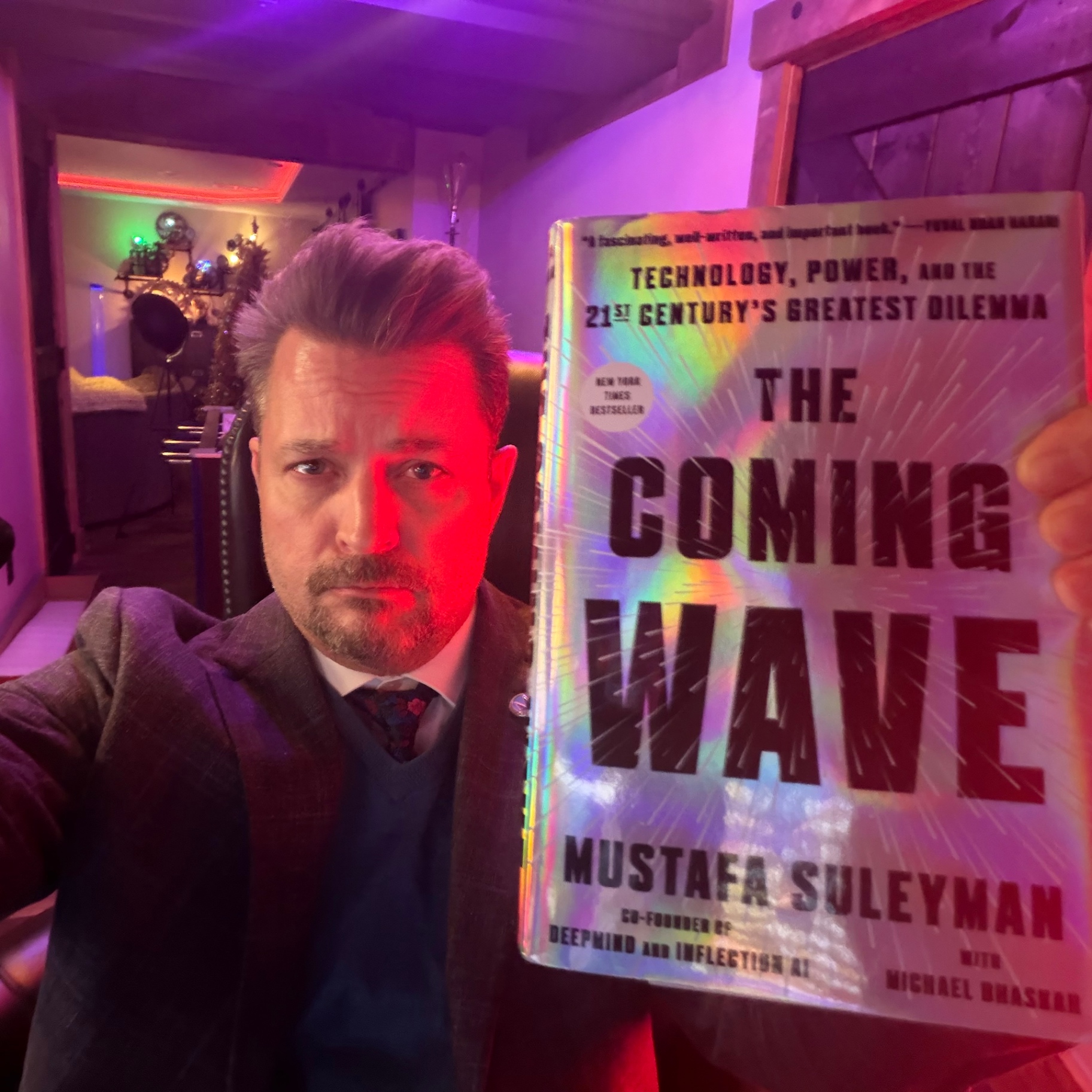
"Containment will only work precisely when everyone gets involved, building a global movement. Think about climate change; the meaningful response only started when it became a major priority for ordinary people, not just scientists or activists."
— Mustafa Suleyman, The Coming Wave
There is a temptation to view this as a dispute between elites—a Silicon Valley startup arguing with Pentagon generals over a $200 million contract. That framing is dangerously incomplete. What is at stake is not a contract. What is at stake is whether three hundred and thirty million Americans will have any hand in shaping the technology that will restructure their economy, redefine their work, educate their children, and govern their communities within the next decade.
The Anthropic-Pentagon dispute is not the problem. It is the symptom. The problem is the vast, silent absence at the center of this transformation: us. The public. The people who will live inside whatever AI future gets built. Right now, the rules of that future are being haggled over in bilateral meetings between defense secretaries and CEOs, in closed procurement negotiations, and in classified briefings that no voter will ever read. That is not democracy. It is oligarchy by default—not because anyone planned it, but because the rest of us have not yet shown up.
The Suleyman Principle: Everyone Gets Involved
Mustafa Suleyman—co-founder of DeepMind, CEO of Microsoft AI, and one of the architects of modern artificial intelligence—has been sounding this alarm for years. In his book The Coming Wave and in his work with the Partnership on AI, Suleyman has made the case that governing AI cannot be left to governments alone, because governments neither fully understand nor control the technology. It cannot be left to companies alone, because companies answer to shareholders, not citizens. And it cannot be left to technologists alone, because the consequences of AI radiate far beyond the engineering lab.
Suleyman's framework is not about fear. It is about agency. His argument is that meaningful AI governance will only emerge when it becomes a major priority for ordinary people—not just researchers, not just activists, not just legislators. Everyone. Parents thinking about what their children's job market will look like. Small business owners wondering whether AI will automate their industry or supercharge it. Workers asking whether the productivity gains will be shared or hoarded. Veterans and military families who care deeply about how the tools of war are governed. Teachers, lawyers, doctors, tradespeople, farmers—everyone whose life will be reshaped by these systems.
This is not idealism. This is survival-level pragmatism. The decisions being made right now—in this dispute, in this Congressional session, in the next twelve months of AI development—will set the trajectory for generations. And those decisions will either reflect the values and interests of the broad public, or they will reflect the interests of whichever small group of people happened to be in the room.
Lightning-Round Legislation: The Democratic Infrastructure We Need
The traditional legislative process was not designed for a technology that doubles in capability every six to twelve months. By the time a conventional bill moves through committee hearings, markup, floor debate, conference, and presidential signature, the AI landscape has already shifted beneath it. Congress's inaction is not merely a failure of political will—it is a structural mismatch between the speed of technological change and the speed of democratic institutions.
The answer is not to bypass democracy. The answer is to accelerate it. We need new mechanisms for rapid, responsive, adaptive legislation—what might be called lightning-round lawmaking. The DPA reauthorization in September 2026 provides a concrete vehicle. The annual National Defense Authorization Act provides another. But beyond specific bills, we need standing frameworks: bipartisan AI oversight commissions with real authority, mandatory sunset clauses that force regular re-evaluation of AI rules as the technology evolves, and expedited legislative tracks for AI governance that match the pace of the technology itself.
Other democracies are already experimenting. The EU AI Act, for all its imperfections, represents the most ambitious attempt to set comprehensive AI rules in any jurisdiction. The UK has proposed agile, sector-specific regulation. Singapore has developed adaptive governance models for emerging technology. America—the nation that invented this technology—has no comprehensive framework at all. The Anthropic dispute should be the catalyst that changes that.
On-the-Pulse Polling: Real-Time Democratic Input
Here is a question that no official has asked the American people: Do you believe the military should be allowed to use AI to conduct mass surveillance of American citizens? Do you believe machines should be authorized to kill without a human decision? These are not technical questions. They are not questions that require a security clearance or a PhD in machine learning. They are questions of values, and in a democracy, the people's values are supposed to matter.
We have the technology to ask. Real-time opinion polling, digital town halls, structured public comment systems, AI-assisted deliberation platforms—the tools for mass democratic participation exist today. What is missing is the political will to use them, and the public demand that they be used. Imagine a legislative process in which, before any major AI governance decision, the public is polled not with a simple yes-or-no survey but with informed deliberative processes—where citizens receive briefings on the stakes, hear arguments from multiple perspectives, and register considered opinions that legislators are required to address on the record.
This is not science fiction. Deliberative polling has been practiced and studied for decades. Digital democracy platforms are operational in multiple countries. The question is whether we will deploy them for the most important governance challenge of the century, or continue to let AI policy be set by whoever shouts loudest on social media and whoever sits across the table from a defense secretary.
Shaping the New Economy: Your Stake Is Real
The economic dimension of this fight is often overlooked, but it may be the most consequential of all. AI is not merely a defense technology. It is an economic revolution. McKinsey estimates that generative AI alone could add trillions of dollars in value to the global economy annually. That value will be created, distributed, and captured according to rules that are being written right now—and the Anthropic-Pentagon dispute is a preview of how those rules will be set if the public is not at the table.
Consider the supply chain risk designation from a purely economic perspective. Anthropic, valued at approximately $380 billion, is one of America's most valuable technology companies. Eight of the ten largest companies in the United States reportedly use its products. Its planned IPO would create wealth and opportunity across the technology sector. The designation—wielded as punishment for a contractual disagreement—threatens to destabilize that ecosystem, not because of any genuine security concern, but because the executive branch wanted to make a point.
Now extrapolate. If the government can threaten any AI company with economic annihilation for refusing to comply with executive demands, then the market for AI innovation in America will be shaped by political compliance, not technological merit. The companies that thrive will not be the ones that build the best or safest products—they will be the ones most willing to say yes to whoever holds power. That is the opposite of the innovation economy. It is a command economy with extra steps.
The alternative is an AI economy governed by transparent rules, shaped by public input, and open to competition on merit. An economy where small businesses can deploy AI tools with confidence that the regulatory landscape will not shift overnight based on a presidential tweet. Where workers can invest in AI skills knowing that the industries they're entering have stable, democratically determined governance frameworks. Where entrepreneurs can build AI companies without fearing that a political disagreement will get them branded a national security threat. That economy is possible. But only if we build it together.
The Participation Imperative
Suleyman is right: contained technology will be built by its critics, not by blind cheerleaders. The same principle applies to AI governance. Good rules will be written by a society that is informed, engaged, and insistent—not by a society that delegates the most consequential decisions of the century to a handful of executives in Washington and San Francisco.
This means you. Not abstractly. Not eventually. Now. The DPA reauthorization is this fall. Congressional hearings are beginning. The Protect Democracy coalition is gathering signatures for a letter demanding Congressional oversight. AI governance organizations are forming. Public comment periods on AI regulation are open. Every citizen who contacts their representative, signs a petition, attends a town hall, or simply pays attention to this fight makes it harder for the rules to be set in the dark.
The Anthropic case has ripped away the curtain. It has shown us exactly how AI governance decisions are being made—through ultimatums, threats, and executive power plays with no democratic accountability. That visibility is a gift. It will not last forever. The question is whether we use this moment to demand a seat at the table, or whether we let the curtain fall back and accept whatever future gets built for us instead of by us.
The technology is moving. The economy is transforming. The rules are being written. The only question is whether the American people will be authors of those rules, or merely subjects of them.
PART IV: THE NEXT TWELVE MONTHS
How the Battle Unfolds
The Legal Gauntlet
Within weeks, Anthropic will file suit challenging the supply chain risk designation. The case will likely be brought in federal district court, possibly in the D.C. Circuit given the concentration of national security law expertise. The company will seek a temporary restraining order and preliminary injunction to prevent the designation from taking full effect during litigation. Given the procedural deficiencies already identified by multiple legal scholars, a TRO is plausible. Courts have shown willingness to enjoin executive action that exceeds statutory authority, particularly when procedural requirements have been demonstrably unmet.
Simultaneously, Congressional pressure will intensify. The DPA comes up for reauthorization by September 30, 2026, and the Anthropic dispute will be at the center of those deliberations. Expect bipartisan hearings examining both the supply chain risk designation and the DPA threat, with legal scholars, AI company executives, civil liberties organizations, and defense officials all testifying.
The Technology Accelerates
While the legal battle plays out, the AI itself will advance dramatically. By mid-2026, multiple companies will be deploying models with significantly greater reasoning, planning, and autonomous action capabilities than anything available today. The questions that seem abstract in February—Can an AI reliably make lethal targeting decisions? Can an AI surveillance system truly monitor an entire population?—will become terrifyingly concrete.
Anthropic's planned IPO, reportedly in preparation for 2026, adds financial complexity. The supply chain risk designation was clearly designed to inflict maximum damage on the company's enterprise relationships and valuation at exactly the moment when investor confidence matters most. Whether this was calculated or coincidental, the market will be watching the litigation closely. If Anthropic prevails in early legal skirmishes—particularly on a TRO—its position strengthens. If the designation is allowed to stand during litigation, the business pressure becomes immense.
The Legislative Window
The DPA reauthorization creates a once-in-a-decade opportunity. If Congress uses this vehicle to establish substantive rules for military AI—defining the boundaries of permissible AI surveillance, establishing human-in-the-loop requirements for lethal autonomous systems, and creating transparency and reporting obligations—the Anthropic dispute becomes the catalyst for the framework the country desperately needs.
Simultaneously, the presidential election cycle will force candidates to articulate positions on AI governance. Public pressure, shaped by the visibility of the Anthropic case, can make military AI a campaign issue. Not a niche technology policy question, but a question of fundamental rights: Do you believe the government should be able to use AI to surveil you without a warrant? Do you believe machines should be authorized to kill without a human decision?
The Appellate Fight and the New Congress
If the district court reaches a merits decision—on the statutory challenge, the scope of the designation, or the constitutional questions—an appeal is certain regardless of which side prevails. The appellate briefing will attract an extraordinary coalition of amici curiae: technology companies, civil liberties organizations, constitutional scholars, former military and intelligence officials, allied governments, and international organizations. The questions presented will be genuinely novel, and the eventual circuit court opinion will be the most significant statement on the intersection of national security power and technology company autonomy since the NSA surveillance cases of the 2010s.
By this point, the contours of a new AI governance framework should be emerging from Congress, driven by the urgency that the Anthropic case created. Whether that framework resembles what Anthropic advocates—explicit restrictions on mass surveillance and autonomous weapons—or what the Pentagon demands—executive discretion bounded only by existing law—depends entirely on whether the public demands a seat at the table.
PART V: THE STAKES
Why This Moment Demands Your Attention
There is an arc to these things. The surveillance state did not arrive fully formed on September 12, 2001. It was built incrementally, one authority at a time, each justified by urgency, each normalized by repetition, until Edward Snowden revealed a system that most Americans could not have imagined their government possessed. The tools we are discussing now—AI-powered surveillance, autonomous weapons—are orders of magnitude more powerful than anything that existed in 2013. And they are being deployed with even less democratic deliberation.
Anthropic is, at this moment, the only major AI company that has publicly and unequivocally refused to provide its technology without guardrails against the most dangerous applications. OpenAI secured the same protections through quieter means—embedding restrictions in its Pentagon deal while publicly agreeing to "all lawful purposes." Google has not commented. The market dynamics are clear: every company is being pressured to comply, and the costs of resistance are being made spectacularly visible through Anthropic's example.
That is precisely why this moment matters. The decision being made right now is not about one company or one contract. It is about whether the rules governing the most consequential technology of our lifetime will be set by democratic institutions accountable to the people, or by executive fiat accountable to no one. It is about whether the principle of democratic governance survives the transition to the AI age, or whether it is quietly buried under the weight of national security claims that brook no questioning.
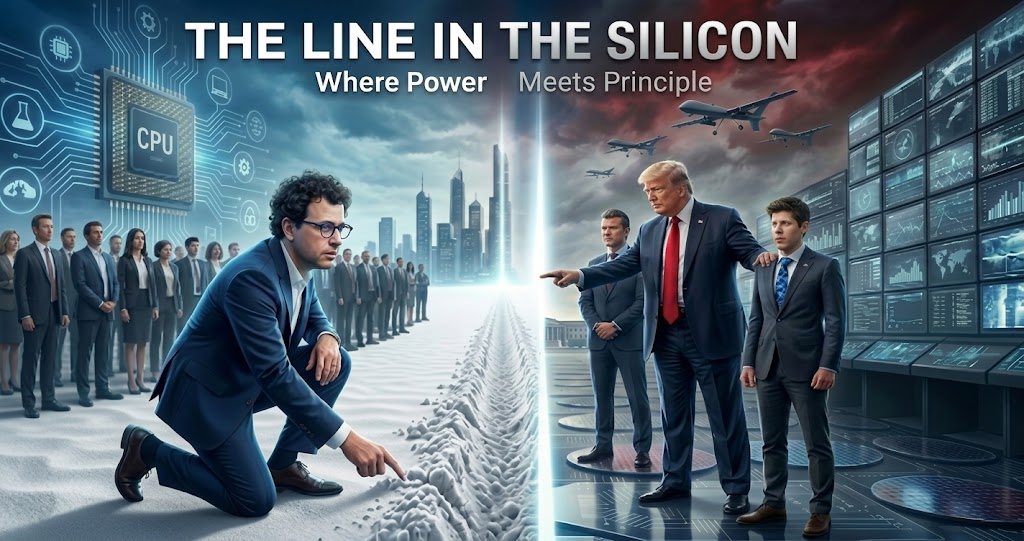
Anthropic is drawing a line. The question is whether the rest of us will stand on it.
CONCLUSION: THE CASE FOR INVOLVEMENT
In every era, there are moments when the trajectory of power becomes visible—when the mechanisms by which authority expands and accountability contracts are laid bare for anyone willing to look. We are in such a moment.
The Anthropic-Pentagon dispute is not a technology story. It is a governance story. It is the story of whether the people of the United States will have any say in how artificial intelligence—a technology that will reshape every institution in society—is developed, deployed, and constrained. It is the story of whether constitutional principles drafted in an age of quill pens can survive an age of algorithms.
The path forward requires three things from all of us.
Attention
This story is unfolding now. It is not waiting for us to catch up. The legal challenges, the Congressional hearings, the DPA reauthorization, the campaign debates—all of this will happen in the next twelve months, and public awareness will determine whether it happens in the open or in the shadows.
Involvement
Contact your representatives. Support organizations litigating for AI transparency and accountability. Demand that candidates articulate positions on autonomous weapons and AI surveillance. The Protect Democracy coalition has already launched a letter calling for Congressional oversight. Sign it. Share it. Add your voice to it.
Leadership
The professionals who build, deploy, regulate, and litigate over AI technology have a special obligation. Lawyers, engineers, policymakers, educators—we are the ones who understand the technical realities and the legal frameworks. If we do not lead this conversation, it will be led by those who benefit from keeping the public uninformed.
What Anthropic is doing is not easy. It is not costless. It is, in the most literal sense, putting its business at risk to preserve principles that protect all of us. You do not have to agree with every position Anthropic takes. You do not have to trust any company to be the permanent guardian of democratic values. But you should recognize that when a company stands alone against the full weight of executive power and says "no, not this, not like this," it creates a space—a brief, fragile space—in which the rest of us can organize, legislate, and build the durable frameworks that no single company should have to carry.
That space will not stay open forever. The six-month phaseout has begun. The legal clock is ticking. Congress has a legislative window that will close. And the technology is advancing faster than any of our institutions can respond.
The question is not whether AI will be used for national defense. It will. The question is whether it will be used with the guardrails that a free people demand, or without them. That question belongs to all of us. Not to a CEO. Not to a Secretary of War. To us.
"In the end, we will remember not the words of our enemies, but the silence of our friends."
— Dr. Martin Luther King Jr.
LEGAL NOTICE
This analysis is provided for informational and public education purposes. It constitutes legal commentary and policy analysis based on publicly available sources as of February 28, 2026. It does not constitute legal advice and should not be relied upon as such. The author's analysis of statutory requirements, constitutional questions, and litigation prospects reflects independent assessment of the legal landscape and does not represent the positions of any party to the disputes described. All factual claims are sourced from published reporting by Reuters, NPR, CBS News, CNN, Fortune, CNBC, The Hill, Lawfare, and other outlets of record.
AI Disclaimer: This article was human-reviewed but may contain AI-generated elements. Readers are encouraged to conduct their own research and remain skeptical of any factual errors.