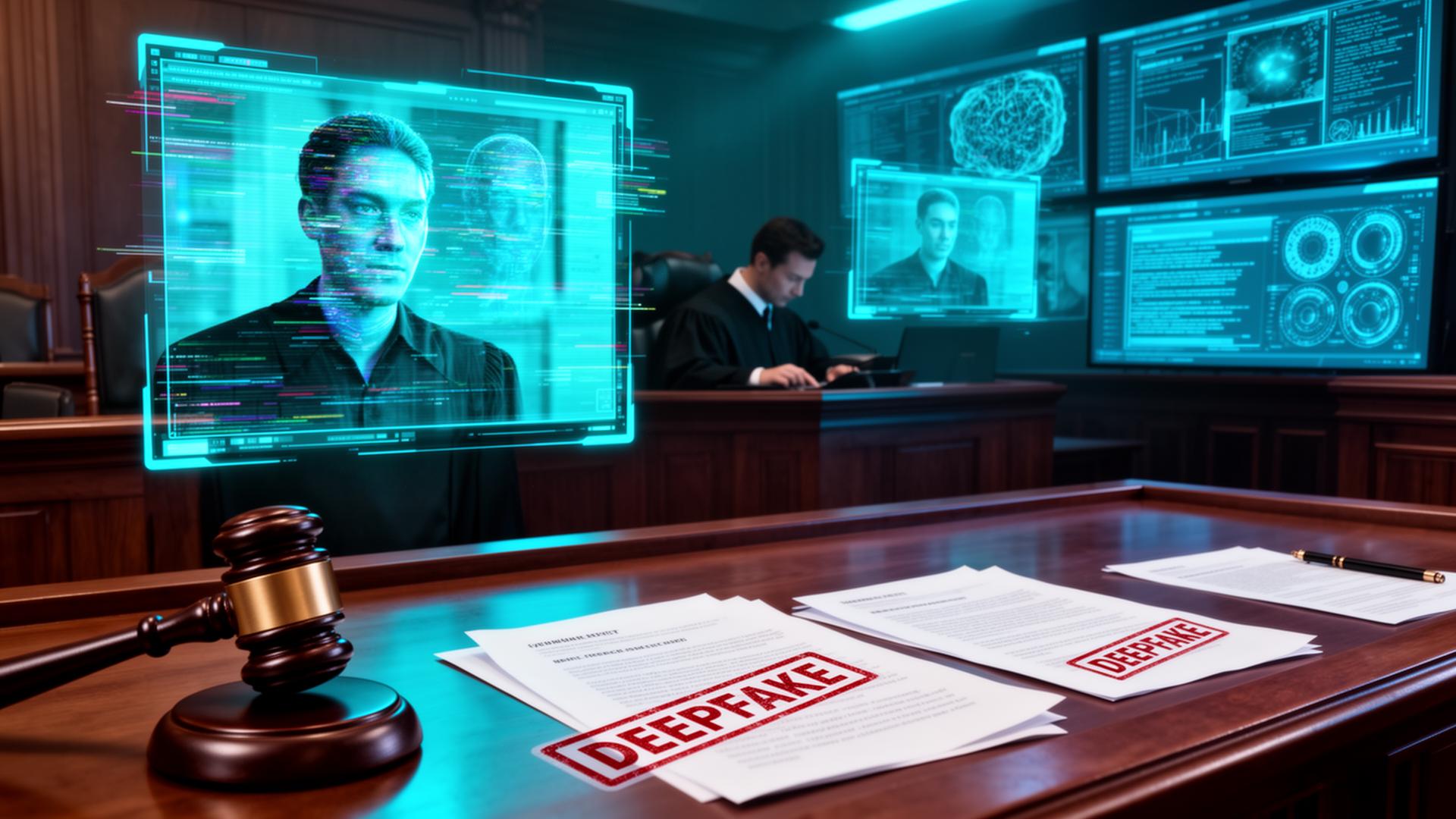

Artificial intelligence has crossed a critical threshold. Deepfakes and synthetic evidence are no longer theoretical risks or academic curiosities; they are actively influencing arrests, civil judgments, and regulatory enforcement actions. Courts are now confronting a new evidentiary reality where text messages, images, audio recordings, and even video testimony may be entirely fabricated yet appear facially authentic.
For legal practitioners, this shift demands immediate procedural and strategic adaptation. This article provides a practical framework for identifying AI-generated evidence, litigating authenticity disputes, and protecting clients and courts from synthetic media abuse.
The New Evidentiary Threat Landscape
Deepfakes exploit long-standing assumptions embedded in evidentiary law: that digital evidence is difficult to fabricate at scale, that visual realism implies authenticity, and that metadata alone is sufficient for verification. None of these assumptions reliably hold true today.
AI Systems Can Now Generate:
- •Photorealistic images of real people engaging in acts that never occurred
- •Convincing audio recordings mimicking specific voices
- •Text message logs and emails that appear native to real platforms
- •Video evidence indistinguishable from genuine recordings without expert review
The result is a collapse of visual trust that places new burdens on attorneys, judges, and forensic experts alike.
Early Detection of Synthetic Evidence
Use this checklist as soon as AI-generated evidence is disclosed or suspected:
- Identify whether the evidence was created, enhanced, or modified using AI tools
- Request original source files rather than screenshots or exports
- Examine metadata for inconsistencies in timestamps, device identifiers, or software signatures
- Determine whether the producing party can identify the creation method, platform, or model used
- Flag unusually high-quality media that lacks corroborating contemporaneous records
- Consult a forensic expert early if authenticity is disputed
💡 Practice Tip: Treat unexplained polish or clarity in digital evidence as a red flag, not a strength.
Authentication Is No Longer Mechanical
Traditional authentication focused on witness testimony or basic metadata review. In the age of generative AI, courts are increasingly receptive to deeper scrutiny, including:
- •Examination of prompt history or generation logs
- •Hash value comparison across versions
- •Model version identification and reproducibility testing
- •Expert testimony on generative artifacts and model limitations
Authentication has become a technical inquiry, not merely a foundational formality.
Challenging AI-Generated Evidence
Use this checklist when seeking exclusion or limitation:
- File a motion in limine targeting authenticity and reliability
- Demand disclosure of all AI tools used in creation or enhancement
- Request prompt logs, generation parameters, and model version data
- Retain a qualified forensic or AI expert to evaluate artifacts
- Argue prejudice and jury confusion under Rule 403
- Request a pretrial reliability hearing where appropriate
💡 Practice Tip: Courts are increasingly persuaded by arguments focused on jury misinterpretation risk, not just fabrication.
Preservation and Spoliation Risks
AI-generated evidence introduces new preservation duties. Prompts, intermediate outputs, model settings, and version histories may all be relevant to authenticity. Failure to preserve these materials can compromise both admissibility and credibility.
Firms should assume that AI-related provenance is discoverable when synthetic media is at issue.
Preservation and Discovery Safeguards
- Issue preservation letters explicitly covering AI prompts and outputs
- Preserve all versions of disputed media files
- Document software platforms, versions, and update histories
- Secure expert evaluation before data degradation occurs
- Track chain of custody for digital artifacts meticulously
💡 Practice Tip: Preservation failures involving AI artifacts may be treated more harshly than traditional ESI gaps due to heightened abuse potential.
Judicial Gatekeeping Is Expanding
Judges are no longer waiting for juries to encounter synthetic evidence before intervening. Increasingly common judicial tools include:
- •Pretrial admissibility hearings
- •Enhanced limiting instructions
- •Expert testimony requirements
- •Explicit warnings regarding AI-generated media
Courts are recognizing that once a deepfake is seen, its prejudicial impact may be impossible to fully undo.
Advising Judges and Courts
For litigators and clerks assisting the court:
- Propose tailored jury instructions on synthetic media
- Recommend bifurcated hearings on authenticity
- Provide judicial education materials on generative AI
- Offer neutral expert options when appropriate
- Emphasize due process and evidentiary integrity concerns
Ethical and Professional Responsibility Implications
Knowingly submitting AI-generated false evidence is not merely aggressive advocacy; it is a potential ethics violation. Lawyers must now supervise not only human staff but also the tools used to generate client-facing and court-facing materials.
Competence increasingly includes AI literacy.
Ethical Compliance and Risk Management
- Train staff on identifying AI-generated content
- Prohibit unsupervised use of generative tools for evidentiary materials
- Document verification steps for digital submissions
- Update firm policies to address AI-assisted evidence
- Disclose AI involvement where required or strategically advisable
The LegalTek Perspective
Deepfakes represent a structural challenge to the legal system, not a passing trend. Lawyers who treat AI-generated evidence as a novelty risk catastrophic procedural and ethical failures. Those who adapt early will define the next era of evidentiary practice.
At LegalTek.ai, we view this moment not as a threat, but as an opportunity to modernize legal safeguards, strengthen due process, and restore trust through informed advocacy.
Sample Motion in Limine
Template for excluding or limiting AI-generated evidence
MOTION IN LIMINE TO EXCLUDE OR LIMIT
AI-GENERATED OR AI-MANIPULATED EVIDENCE
WITH PROPOSED ORDER
IN THE [COURT NAME]
[COUNTY], [STATE]
[PLAINTIFF],
Plaintiff,
v.
[DEFENDANT],
Defendant.
Case No. [________]
Judge [________]
MOVANT'S MOTION IN LIMINE TO EXCLUDE OR, IN THE ALTERNATIVE,
TO LIMIT ADMISSION OF AI-GENERATED OR AI-MANIPULATED EVIDENCE
Now comes [Movant], by and through undersigned counsel, and respectfully moves this Honorable Court for an order excluding, or in the alternative strictly limiting, any evidence that was generated, altered, enhanced, or synthesized using artificial intelligence or similar automated systems (collectively, "AI-Generated Evidence"), unless and until the proponent establishes admissibility through a pretrial evidentiary hearing.
In support of this Motion, Movant states as follows:
I. INTRODUCTION
This Motion addresses a threshold evidentiary issue of growing importance. Artificial intelligence technologies can now generate highly realistic images, audio recordings, videos, and digital communications depicting events that never occurred. Once presented to a jury, such material carries an outsized persuasive effect that may irreparably prejudice the fact-finding process.
Because AI-Generated Evidence may be entirely synthetic or materially altered in ways undetectable to lay jurors, pretrial judicial scrutiny is essential to ensure reliability, fairness, and due process.
II. SCOPE OF DISPUTED EVIDENCE
This Motion applies to any proposed evidence that falls within one or more of the following categories:
- Images, video, or audio created, enhanced, manipulated, or synthesized using AI tools
- Text messages, emails, or digital communications generated or altered by generative AI systems
- Audio or video purporting to depict a person's voice or likeness that was created or modified using AI
- Demonstrative exhibits relying on AI reconstruction, simulation, enhancement, or interpolation
The proponent has not disclosed the provenance, creation method, or technical reliability of such materials.
III. GOVERNING LEGAL PRINCIPLES
A. Authentication
Evidence must be supported by sufficient proof that it is what its proponent claims. Where evidence is susceptible to undetectable fabrication, foundational testimony alone is insufficient. AI-Generated Evidence presents a heightened risk because it may have no original source event and may not be independently verifiable.
B. Unfair Prejudice and Jury Confusion
Even relevant evidence must be excluded when its probative value is substantially outweighed by the danger of unfair prejudice, confusion of the issues, or misleading the jury. Highly realistic synthetic media poses a unique risk of jurors assigning unwarranted credibility based on appearance rather than reliability.
C. Due Process and Fundamental Fairness
Admission of AI-Generated Evidence without meaningful validation threatens the integrity of the trial process and risks verdicts based on illusion rather than proof.
IV. ARGUMENT
A. AI-Generated Evidence Cannot Be Properly Authenticated Without Technical Disclosure
The proponent has failed to establish:
- The specific AI tool or model used
- The inputs, prompts, parameters, or training data relied upon
- Whether the output is wholly synthetic or partially altered
- Whether the output can be reproduced or independently validated
Without this information, authentication is impossible.
B. The Risk of Irreparable Prejudice Substantially Outweighs Any Probative Value
Once jurors view or hear realistic synthetic media, its influence cannot be fully neutralized by cross-examination or limiting instructions. The risk of unfair prejudice substantially outweighs any probative value.
C. A Pretrial Reliability Hearing Is Required
Because AI-Generated Evidence involves technical issues beyond the common knowledge of lay jurors, admissibility must be determined outside the presence of the jury through a focused evidentiary hearing.
V. REQUEST FOR RELIEF
Movant respectfully requests that this Court:
- Exclude any AI-Generated Evidence unless and until admissibility is established at a pretrial hearing
- Require full disclosure of all AI tools, software versions, prompts, parameters, and workflows used
- Require expert testimony as a prerequisite to authentication
- Prohibit reference to disputed AI-Generated Evidence in opening statements
- Alternatively, impose strict limitations and tailored jury instructions should admission be permitted
VI. CONCLUSION
Artificial intelligence has fundamentally altered the evidentiary landscape. Without rigorous judicial gatekeeping, AI-Generated Evidence threatens to undermine the reliability of verdicts and the fairness of proceedings. Pretrial exclusion or limitation is therefore necessary and appropriate.
Respectfully submitted,
[Attorney Name]
[Bar Number]
[Firm Name]
[Address]
[Phone]
[Email]
Proposed Order
Template court order granting the motion
PROPOSED ORDER
IN THE [COURT NAME]
[COUNTY], [STATE]
[CASE CAPTION]
Case No. [________]
ORDER GRANTING MOTION IN LIMINE REGARDING
AI-GENERATED OR AI-MANIPULATED EVIDENCE
This matter came before the Court on [date] upon [Movant]'s Motion in Limine to Exclude or Limit AI-Generated or AI-Manipulated Evidence. The Court, having reviewed the Motion, any opposition, and being otherwise fully advised, hereby ORDERS as follows:
- Any evidence that was generated, altered, enhanced, or synthesized using artificial intelligence or similar automated systems shall be excluded unless and until the proponent establishes admissibility at a pretrial evidentiary hearing.
- Prior to any such hearing, the proponent shall disclose all AI tools, software versions, prompts, parameters, workflows, and related materials used in the creation or modification of the proposed evidence.
- No reference to disputed AI-Generated Evidence shall be made in opening statements or before the jury unless and until admissibility is determined by the Court.
- If the Court permits admission of any AI-Generated Evidence, such admission shall be subject to strict limitations and appropriate jury instructions as determined by the Court.
IT IS SO ORDERED.
Date: [________]
[Judge's Name]
Judge, [Court Name]
AI Disclosure: This article was prepared with AI assistance for research and drafting. All content has been reviewed and edited by a licensed attorney. Readers should verify all citations and consult jurisdiction-specific rules before relying on any procedural guidance.