The Dawning of an Era of Abundance
"This is the dawning of the rest of our lives on holiday," sang Green Day – a lyric that feels uncannily apt today. We stand on the cusp of a future where life could indeed start to feel like an extended weekend or perpetual holiday. Rapid advances in technology are making it possible to transition away from a work-centered economy and towards an age of abundance. Automation and artificial intelligence are advancing so quickly that a fully post-scarcity society – one in which machines provide for our basic needs with minimal human labor – is now serious discourse, not science fiction.
As early as 1930, the economist John Maynard Keynes envisioned that by now technological progress would enable a 15-hour workweek, wondering how people would find purpose with so much leisure time. Nearly a century later, that once-hypothetical scenario is within reach.
Futurists even predict that we may soon conquer one of life's ultimate limitations: aging itself. Ray Kurzweil, a prominent inventor and futurist, believes humanity will achieve "longevity escape velocity" by the 2030s – meaning medical advances will extend our life expectancy faster than we age. In other words, our lives could be not only more leisurely, but much longer too. Imagine a world where you have decades (perhaps centuries) of healthy life, and material needs are largely met by automated systems. Essentially, it's as if the whole of humanity is entering a permanent holiday with limitless potential for personal growth. This optimistic vision carries a "religion of abundance" mindset – a near-spiritual belief that technology can provide plenty for all, freeing us to focus on higher aspirations instead of mere survival.
However, transitioning into this new economy of abundance is not as simple as flipping a switch. Human beings have spent millennia in societies where work was tied to survival and purpose. What happens when the old structure of a working life falls away? Will we find ourselves blissfully on "vacation" forever – or facing an existential void? Some scholars have voiced a "post-scarcity paradox" – the worry that when survival is guaranteed and scarcity eliminated, people might experience a loss of meaning or drive. After all, much of human motivation historically comes from striving to overcome challenges and meet needs. If obtaining food, shelter, and security is no longer a struggle, "obtaining resources is no longer a meaningful purpose in itself," as one analysis notes. In a world where material scarcity is solved, what will we do with ourselves? Will we suffer "nihilism and 'boredom in utopia'" or adapt by creating new sources of fulfillment?
The answer is up to us – and it's a profoundly positive one if we choose. Humans are remarkably adaptable and creative. Rather than falling into meaninglessness, we can consciously craft a new way of life that is rich in purpose, freedom, and community.
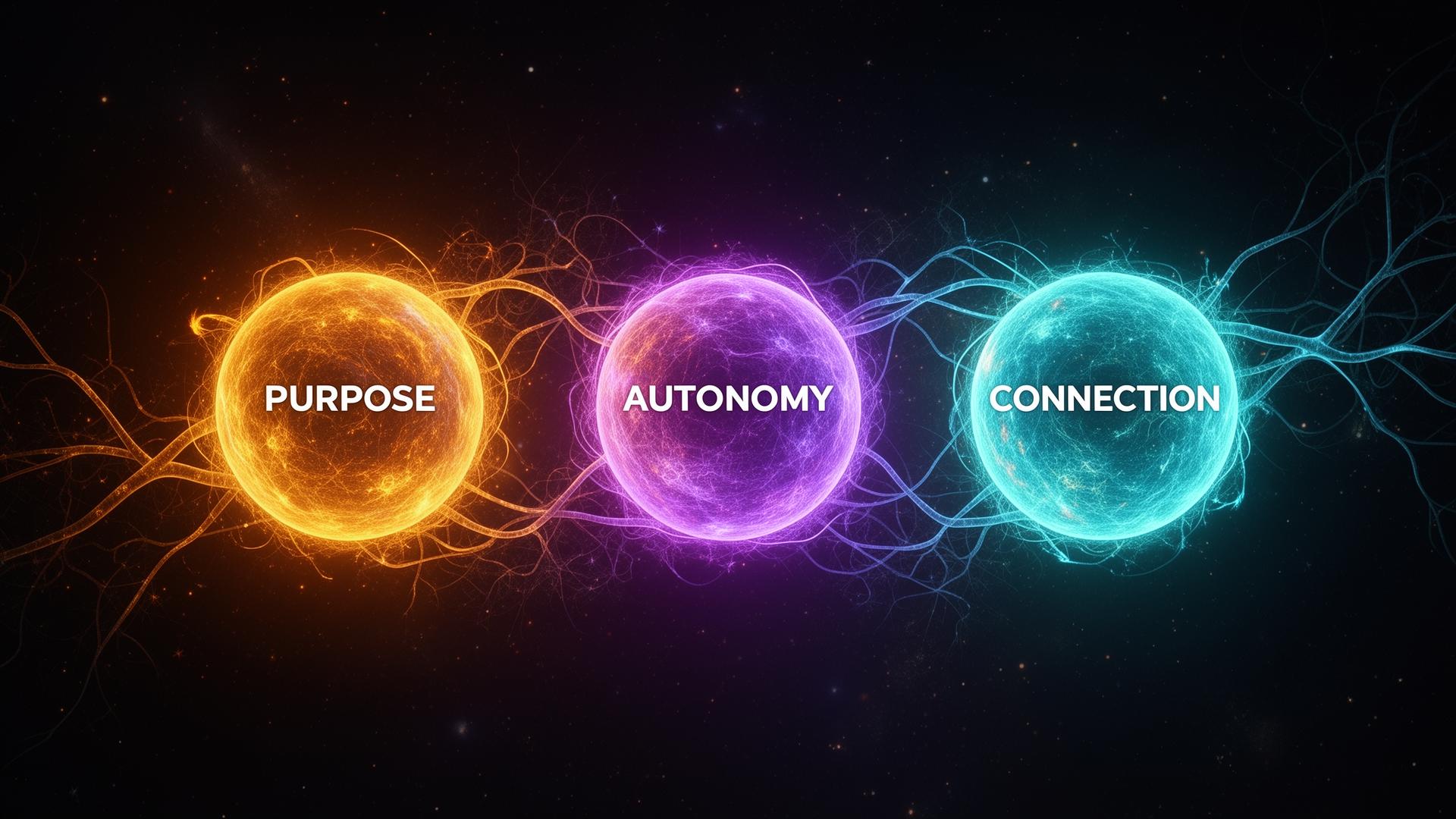
At the heart of this transition are three psychological pillars: Purpose, Autonomy, and Connection (PAC). By fostering PAC in the new economy, we can ensure that an age of abundance becomes an age of fulfillment. Think of PAC as the core ingredients for human flourishing when work as we know it is no longer the center of life.
Why Purpose, Autonomy, and Connection Matter
Even if our jobs disappear and our material needs are met, human nature doesn't change overnight. Psychology tells us that people still require certain key experiences to be happy and motivated. Decades of research on human well-being point to purpose, autonomy, and connection as fundamental human needs. In fact, Self-Determination Theory, a well-established psychological framework, holds that all people have three basic psychological needs – autonomy, competence, and relatedness (connection) – that underlie our growth and fulfillment. When these needs are satisfied, we thrive; when they are neglected, our motivation and well-being suffer. In short, beyond food and shelter, we need things to do that feel meaningful, freedom to choose our path, and relationships with others.
Modern thinkers in business and education have reached similar conclusions. For example, author Daniel Pink famously argued that intrinsic motivation in work comes from "autonomy, mastery, and purpose," rather than just money or rewards. People are driven in lasting ways by the desire to direct their own lives, to develop mastery in something, and to do things that matter. Take away the traditional workplace, and those same drives remain. We will still wake up in the morning asking: What am I going to do today that matters to me or others? Do I have control over my life? Who am I going to share the day with? Purpose, autonomy, and connection are the answers to those questions.
Crucially, having all the free time in the world won't guarantee happiness by itself. Research shows that too much idle time can actually reduce well-being if that time isn't used in fulfilling ways. In one study of thousands of people, subjective well-being rose as free time increased – but only up to a point. Beyond about 5 hours of leisure per day, happiness began to decline, with participants reporting a lower sense of well-being. The reason? People with endless free hours often felt a "lacking sense of productivity and purpose," the researchers found. In other words, having nothing obligatory to do can become a curse if life feels aimless.
The good news is that the same study also pointed to a solution: it's not free time per se that hurts well-being, but how that free time is spent. Those who used their abundant time on social or meaningful activities did not experience the drop in well-being. As the authors put it, people with empty days should try "spending their time with purpose, be it connecting with others or doing something productive." In a future where work is optional, this insight is key: we need to actively fill our days with purpose and connection to stay happy. A life of pure leisure and entertainment, without any sense of contribution or community, tends to leave us feeling empty. But leisure with purpose – such as learning a new skill, creating art, helping a neighbor, or simply bonding with friends – can fuel our well-being.
Human societies have faced this kind of challenge before, albeit on a smaller scale. Think of retirement: many people look forward to the day they can stop working, yet often retirees struggle unless they find new hobbies, social networks, or volunteer roles. Similarly, when the pandemic lockdowns gave some people an unexpected surplus of free time, many discovered the importance of having structure and meaningful activity in their lives. We can learn from these experiences. They all underscore the same lesson: Purpose, Autonomy, and Connection are not luxuries – they are psychological nutrients. In a new economy where the old pressures are lifted, we must double down on providing these nutrients for everyone.
Cultivating Purpose in an Economy of Leisure
Purpose is the sense that our life and our actions have meaning or direction. It's about being part of something bigger than oneself – achieving goals, helping others, creating something valuable, or simply following one's passion. In the traditional economy, many people found purpose through their jobs or professions: the teacher who finds meaning in educating children, or the craftsman who prides himself on building quality goods. In a future where a "job" is no longer needed to secure basic needs, we will have to uncouple purpose from paycheck. The wonderful reality is that purpose can be found in many places outside a job title. The challenge is to nurture those opportunities at a societal scale.
One optimistic scenario is that when freed from menial or compulsory labor, society will reorganize around purposeful activities. Instead of defining ourselves by the work we have to do, we'll define ourselves by the work we choose to do. We might see our economies and communities explicitly prioritize purpose and contribution over profit and consumption. In fact, some visionaries talk about building a "purpose-driven economy." In a purpose-driven economy, success is measured not by GDP alone but by how much people are learning, creating, and contributing to well-being. For example, governments could support programs that enable citizens to engage in research, the arts, caregiving, environmental restoration, and other meaningful projects that benefit everyone. Instead of treating unemployment or free time as a problem, a post-work society could treat free time as an opportunity – a chance for education, creativity, or civic service.
We can already see the seeds of purpose-driven production in today's world. Consider the rise of social entrepreneurship and volunteerism. Many people, even while working, are seeking outlets for meaningful contribution – whether by founding mission-driven companies (like B-Corps that aim for social good) or by volunteering in their communities. The open-source movement in software is a powerful example: communities of programmers around the world collaborate to build free software (like Linux) or knowledge bases (like Wikipedia) with no profit motive at all. They do it for curiosity, for reputation, or simply for the joy of solving a problem and contributing to humanity's knowledge. These projects have created immense public value by harnessing intrinsic motivation and collective purpose – proving that people will work hard even without a salary when they believe in what they're doing. In the future, we could see this ethos spread to many fields: open-source drug discovery, community-run urban farms, citizen science projects, and more, all driven by passion and the desire to have a positive impact.
To foster purpose on a broad scale, education and cultural institutions will play a crucial role. Rather than educating the next generation only for workforce needs, we can shift education toward self-actualization – helping individuals discover their talents, passions, and values. Lifelong learning will likely become the norm: people of all ages continuously exploring new domains, not because they need a new career, but because human beings love to grow and master new things. Imagine a life where you could be a musician for a decade, then a marine biologist for a while, then an astronomer – not out of economic necessity, but out of genuine interest. In a post-work world, that kind of multi-faceted life is more feasible. With basic income or automation providing the essentials, individuals can pursue multiple callings in one lifetime, crafting a personal journey filled with evolving purpose.
Broadening Our Definition of Valuable Work
In the new economy, purpose won't always look like a traditional job. It might look like caring for an elderly neighbor, mentoring disadvantaged youth, creating beautiful art, or contributing to open-source science. These are all deeply purposeful activities that improve our world. A society that has moved beyond the working economy can honor and reward these contributions socially. Our cultural heroes may shift from billionaires to great teachers, inventors, artists, and humanitarians. In essence, if AI and robots take care of the bread (our material needs), humans can focus on the roses – the things that make life beautiful and worth living.
Fostering Autonomy and Personal Freedom
The second pillar, Autonomy, is all about freedom and self-determination. It means having control over your own life – being able to make choices according to your values, and not just following orders or living by someone else's schedule. Autonomy has always been a critical component of happiness; people naturally yearn to be the authors of their own story. Psychologists define autonomy as the need to feel in control of one's own behaviors and goals. When you have autonomy, you believe that your actions can shape your life in meaningful ways, which boosts motivation and satisfaction.
In the traditional working economy, autonomy was often limited. Many of us had to structure our days around jobs, bosses, or the grind of earning a living. Even outside of work, financial constraints or social expectations might have dictated our major life choices. A post-work, abundant economy has the potential to drastically increase personal autonomy. If your livelihood doesn't depend on taking a certain job, you suddenly have a lot more say in how to spend your time. Universal basic income (UBI) or similar measures could provide a safety net so that pursuing education, art, entrepreneurship, or caregiving doesn't come at the cost of your basic needs. Indeed, early experiments with basic income have shown promising results: when people are given a financial floor to stand on, many use the newfound freedom to start businesses, go back to school, or volunteer in their communities. In other words, free from the immediate pressure to "earn or starve," people often exercise their autonomy in productive and creative ways – they don't all just sit around. There is evidence that abundance could be accompanied by new forms of striving; for instance, some UBI pilots have "encouraged entrepreneurship or volunteering" rather than idleness.
To fully foster autonomy, our society will need to empower personal choice at every turn. This can happen on multiple levels. On a societal level, it means maintaining freedoms and opportunities: access to education for any field of interest, the freedom to move or travel, the ability to form communities or start projects without excessive bureaucratic hurdles, and the preservation of personal rights. On a community and organizational level, it means adopting cultures of trust and flexibility. For example, even in today's companies, forward-thinking leaders try to give employees more space to solve problems in their own way, because they know autonomy builds confidence and initiative. Translating that to a broader society: we can create an environment where individuals (or groups) identify problems or goals and have the agency to tackle them in their own creative way, rather than being micromanaged from above.
Education and lifelong learning again play a role here. Autonomy flourishes when people have the skills and knowledge to pursue their interests. A person with a broad education and supportive mentors is better equipped to say, "I want to try building a solar-powered car," and actually go do it, than someone who has been narrowly trained just for one task. Thus, an autonomy-supporting society would give people the tools (skills, knowledge, resources) and then step back and allow them to chart their own course. Imagine learning hubs or workshops open to all ages where you can delve into anything from robotics to music production at your own pace. Or community "makerspaces" with shared tools where anyone can invent and create. These are the kinds of infrastructures that enable autonomous, self-directed activity.
Another facet of autonomy is the freedom to change and evolve. In the new economy, you won't be locked into a single identity of "I am an X (farmer, accountant, etc.) because that's what pays my bills." You could be many things over a long life. As mentioned earlier, lifelong learning and multiple careers or projects become possible when autonomy is high. Today, taking a sharp turn in life (say, quitting your corporate job to become a painter) is a risky move that could jeopardize your income; tomorrow, it might be a normal chapter in one's life story, because financial survival is guaranteed by the system. Enabling people to pivot and try different paths is key to autonomy. It not only makes individuals happier, but it benefits society with a more diverse array of talents and innovations.
Building Connection and Community
The third pillar, Connection, reminds us that no man (or woman) is an island. Human connection – our relationships with family, friends, neighbors, even the broader community – is central to a fulfilling life. We are inherently social creatures; we crave belonging and companionship. In fact, psychologists equate connection (relatedness) with one of the basic needs for well-being. Even if you had all the free time and resources in the world, it wouldn't mean much if you were alone and disconnected. Thus, in a future where work doesn't structure our days, we must be very intentional about fostering social bonds and a sense of community.
Work, for all its stresses, has historically provided a built-in social network and a sense of being part of something. Colleagues, professional communities, clients – these interactions gave us daily contact with others. Remove the office or job site, and there's a risk that people might become isolated if new social structures don't emerge to fill the gap. However, just as with purpose and autonomy, the potential upside is enormous: imagine a world where people have ample time to dedicate to friends, family, and community activities. We could end up with more connection than before, if we cultivate it right.
One of the biggest hurdles in modern life has been time scarcity – families struggling to find time to eat dinner together or neighbors barely knowing each other because everyone's busy working. In an abundant, post-work society, time affluence can become a catalyst for stronger relationships. Studies already show that when people work less, they often invest more in social and civic life. For example, when individuals retire (and are in good health and financially secure), their rates of volunteering and community involvement tend to increase. With more free hours, many turn their attention to helping others or spending time with loved ones. This suggests that given the chance, people will engage with their community rather than isolate. In fact, recall the study about too much free time: it found that those empty hours only harmed well-being if spent in solitary, non-meaningful pursuits – but free time spent on social or productive activities did not have the same negative effect. Connection is a big reason why.
So, how do we engineer a society rich in connection? Part of the answer lies in community design. We can promote social interaction by investing in public spaces and group activities. Picture neighborhoods equipped with vibrant community centers, parks, and co-working or co-creative spaces where people gather not out of necessity, but out of interest. In a post-work city, the community hub might replace the corporate office as the place people go each day – not because they must, but because it's enjoyable and fulfilling to be together and work on something jointly. We might see more co-living arrangements or multigenerational living by choice, as people realize the benefits of sharing life with others when there's no job commute dictating where you live.
A key cultural shift will be recognizing the value of social contributions just as much as economic contributions. In a world of abundance, helping others and strengthening social fabric is the new important work. Communities might adopt the norm that everyone is encouraged to contribute to society in some way – but importantly, "contribution" is defined broadly, not just as paid labor. If you run a free neighborhood yoga class, you're contributing. If you mentor teenagers in science for fun, you're contributing. If you simply check in on elderly neighbors and chat with them daily, that's a contribution. All these acts build connection and trust.
With the "religion of abundance" mindset – trusting that there is enough for everyone – people may feel more open-hearted and generous. Scarcity breeds competition and isolation; abundance can breed gratitude and sharing.
Conclusion: Thriving in the Permanent Holiday
We are on the brink of a truly historic transformation – moving from a world where life is defined by work and scarcity to one defined by abundance and chosen activities. It's as if humanity is about to go on the longest holiday ever, with our needs met and our lifespans potentially stretching out before us. But as we've explored, what could be a hollow paradise of boredom can instead become a thriving garden of human potential if we seed it with Purpose, Autonomy, and Connection.
This transition will require intentional effort and imagination. We have to rethink our institutions, our education, our use of technology, and even our mindsets. But the pieces are already falling into place. Cultural dialogues are turning toward fulfillment and balance. Experiments in basic income and shorter workweeks are teaching us how people behave when given more freedom (and contrary to some fears, most do yearn to do something valuable with their time). Thought leaders are sketching out models of purpose-driven, community-oriented living that sound like something between a renaissance and a golden age. Rather than a collapse into meaninglessness, we are seeing the early signs that people can adapt and create new meanings when circumstances change. Human beings are "versatile meaning-makers," adept at finding passion and purpose in even unlikely situations. Give us a blank canvas of life, and we will paint something beautiful on it.
Imagine telling someone from a hard-labor era, perhaps a 19th-century farmer or a factory worker, that one day their descendants would live in a world of self-driving machines, instant food synthesis, and possibly age-defying medicine. They might respond, "What on earth will people do all day if they don't have to work?" The answer, we can now say, is that we will do what we have always yearned to do: learn, create, play, share, love, and grow. We will pour our energy into solving the great puzzles of science, into arts and culture, into taking care of one another and the planet, into living instead of merely surviving. Our weekend mindset – that feeling of freedom and possibility you get on a Saturday morning – will extend through the weeks and years.
Of course, an endless weekend still needs a sense of purpose to anchor it, a degree of autonomy to feel authentic, and the warmth of others to feel joyful. With PAC as our guide, we can ensure that the New Economy of Abundance is not an era of listless decadence, but one of vibrant human flourishing. Each person can wake up each day not dreading a grind, but excited about what they choose to do. Communities can be bound not by economic necessity but by genuine care and shared interests. And collectively, we can direct our efforts to higher aspirations – from eradicating remaining ills like poverty or disease to exploring the stars or the depths of virtual worlds.
So here's to the dawning of this new era – the dawning of the rest of our lives on holiday. It's up to us to fill that holiday with purpose, to grant ourselves and each other the autonomy to pursue our dreams, and to come together in connection as one human family. By doing so, we turn a potential crisis of meaning into a renaissance of meaning. Freed from toil, but bound by shared humanity, we can finally focus on what truly matters to us. The future beckons, and it's looking bright, abundant, and full of hope – a time when work as drudgery fades, and life as fulfillment begins.
Sources
- Del Valle, I. The Post-Scarcity Paradox: Will Abundance Enabled by AI and Automation Lead to Meaninglessness? (2025) – Analysis of how post-scarcity affects human purpose, and visions of a purpose-driven economy.
- Davis, N. Study links too much free time to lower sense of wellbeing. The Guardian (2021) – Research showing too much idle time lowers well-being due to lost purpose.
- Cherry, K. How Self-Determination Theory Explains Motivation. Verywell Mind (2025) – Overview of autonomy, competence, and connection as basic psychological needs.
- Pink, D. Drive: The Surprising Truth About What Motivates Us – Framework of intrinsic motivators (autonomy, mastery, purpose).
- Kurzweil, R. Longevity Escape Velocity – Prediction that technology will soon allow life expectancy to increase faster than aging.