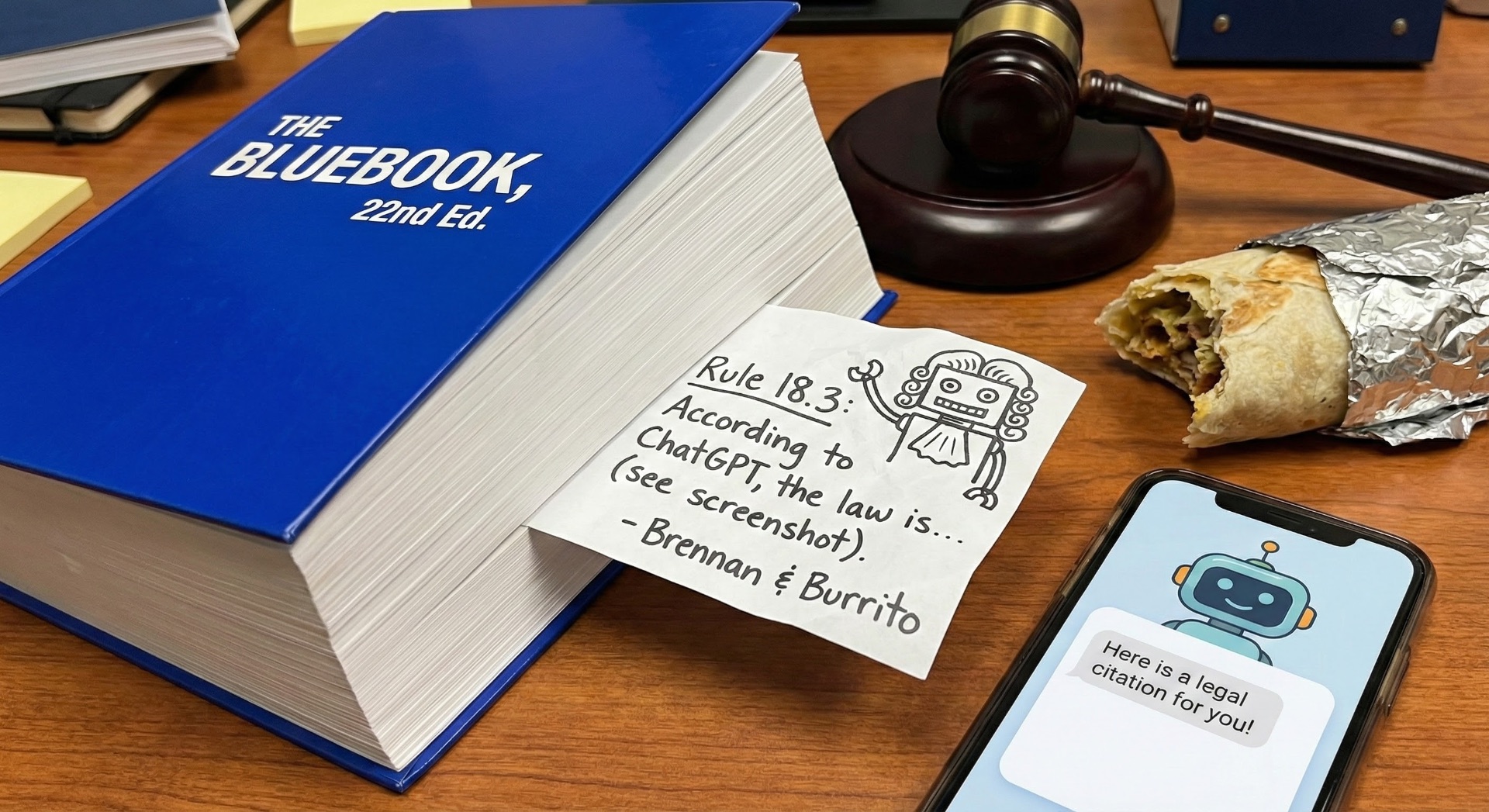

The Bluebook's 22nd Edition dropped in 2025, and buried in its pages is Rule 18.3 — a shiny new citation format for AI-generated content. That's right. The same institution that has spent over a century teaching us the sacred art of citing actual legal authority now wants us to formally cite the robot.
Let me save you some time: if you need this rule, you've already made a mistake.
What Rule 18.3 Actually Requires
Let's walk through it, because it's genuinely something.
Under Rule 18.3(a), if you cite output from a Large Language Model — ChatGPT, Gemini, CoCounsel, whatever — you need to include the name of the person who wrote the prompt, the specific AI model and version, the exact prompt in quotation marks, the date you ran the prompt, and a parenthetical noting where you've stored a PDF screenshot of the output.
Read that again. You need to archive a screenshot of what the chatbot said to you. In a PDF. And then tell the court where you put it.
Rule 18.3(b) does the same thing for search engine results. You need the search engine name, the exact query, the number of results, the date, and — you guessed it — another PDF.
This is the legal citation equivalent of screenshotting a text message from your friend Jerry in office 12 who said "the judge can't do that" and submitting it as Exhibit A.
The Fundamental Problem: You Shouldn't Be Citing This Stuff At All
Here's where the rule falls apart under its own weight.
AI output is not legal authority. It's not a case. It's not a statute. It's not a regulation. It's not even a law review article written by a human who can be cross-examined about their reasoning. It's a probabilistic text generator producing the most statistically likely next word in a sequence. It is, in the most generous possible framing, a very sophisticated research assistant.
And we don't cite research assistants.
Nobody has ever written "According to my 2L summer associate, Brennan, who reviewed approximately 40 cases while eating a Chipotle burrito on June 14, 2024 (PDF on file with author)…" in a brief. And yet here we are, building a citation format for something with roughly the same level of independent legal authority as Brennan and his burrito.
The correct workflow for using AI in legal practice has always been straightforward: use the tool, verify the output, cite the actual authority you verified. You cite the case. You cite the statute. You cite the treatise. You don't cite the thing that helped you find them, any more than you cite Westlaw's search algorithm or the fact that you Googled "adverse possession elements Ohio" at 2 AM.
"But What About Transparency?"
I can already hear the counterargument: "This isn't about citing AI as authority — it's about transparency and disclosure."
Fine. But that's not a citation problem. That's an ethics problem. And courts have been handling it just fine with standing orders requiring attorneys to disclose whether AI was used in preparing filings. You sign a certification. You disclose your tools. Done.
What you don't need is a formal Bluebook citation format that treats ChatGPT's fever dream about maritime law with the same structural dignity as Marbury v. Madison. That's not transparency — that's legitimization. It sends the message that AI output is the kind of thing that can be cited as a source, when the entire thrust of every ethics opinion, court order, and sanctions ruling since 2023 has been: no, it absolutely is not.
Giving lawyers a proper citation format for AI output is like giving someone a formal place setting for eating soup with a fork. You haven't solved the problem. You've just made it look intentional.
What Rule 18.3 Gets Right (Grudgingly)
I'll give the Bluebook this much: the PDF archive requirement isn't stupid.
AI outputs are ephemeral. You can't go back to the same URL and see the same response. The model updates, the response changes, the moment is gone. If you are going to reference AI output — in a law review article discussing AI capabilities, in an academic context, in a filing where the court has specifically asked what your AI said — then yes, you need a record of what it actually produced. The PDF requirement creates that record.
But that's an archiving best practice, not a citation breakthrough. Any lawyer using AI in their workflow should already be documenting their prompts and outputs as part of basic file management and malpractice avoidance. The Bluebook didn't invent that concept. It just slapped a rule number on it.
The Real Lesson Here
The Bluebook has always reflected how lawyers actually work — sometimes a little late, but eventually. Rule 18.3 is the profession catching up to the reality that lawyers are using AI, and some of them are using it badly.
But the rule solves for the wrong problem. The issue was never "how do we properly cite AI output." The issue was — and still is — "how do we stop lawyers from treating AI output as if it were authority."
The answer to that question isn't a citation format. It's training. It's competence. It's the basic professional expectation that when you put something in a brief, you've verified it exists, it says what you claim it says, and it supports the proposition you're citing it for.
If you're doing that correctly, you'll never need Rule 18.3.
And if you're not doing that correctly, Rule 18.3 isn't going to save you.
So by all means, learn the new format. Know it exists. File it away in the same mental drawer where you keep the citation format for medieval manuscripts and papal encyclicals.
And then go cite actual law.
One Small Concession
In fairness — and it pains me slightly to say this — there's a narrow universe where Rule 18.3 earns its keep.
Law reviews are increasingly writing about AI. If you're publishing a piece analyzing how GPT-4 handles Fourth Amendment analysis versus Claude, you need a standardized way to cite the outputs you're examining. That's not citing AI as authority — it's citing AI as the subject of study. And the academic world does need a consistent format for that.
There's also the floor argument. Every Bluebook rule exists because someone, somewhere, did it wrong enough times that standardization became necessary. Lawyers are citing AI output in actual filings right now — badly, without disclosure, without documentation. At least with a formal citation format, the judge can see the model, the prompt, the date, and demand the archived output. That's not legitimization. That's a leash.
But here's the thing: the rule doesn't distinguish between those narrow, defensible use cases and someone dropping "ChatGPT told me the statute of limitations is four years" into a motion to dismiss. It's a general citation format sitting in the Bluebook like it belongs next to Marbury v. Madison. And that structural equivalence — that quiet normalization — is still the problem.
So fine. Rule 18.3 has a pulse. A faint one. In a very small room. With the lights off.
I stand by the rest.