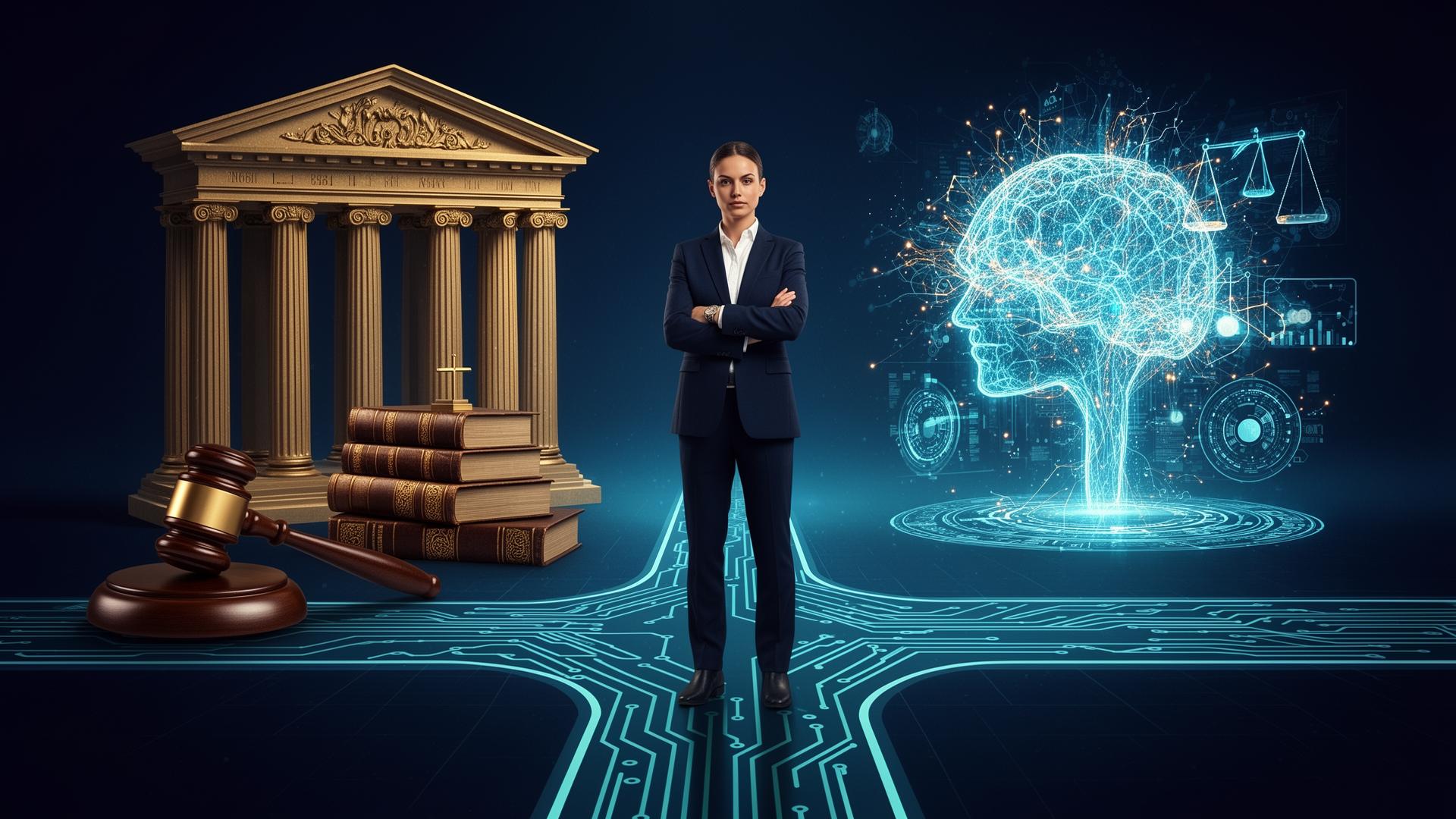
Introduction: The Institutional Challenge
We stand at an inflection point in the history of the legal profession. Artificial intelligence is not merely a new tool in the lawyer's toolkit—it represents a fundamental shift in how legal knowledge is created, discovered, distributed, and applied. To understand what this means for lawyers, we must first understand what lawyers actually do in an economy and why that role matters.
Economists have long recognized that markets do not function in a vacuum. They require institutional infrastructure: clear property rights, enforceable contracts, predictable rules, and mechanisms for resolving disputes. Lawyers are the architects and maintenance workers of this infrastructure. We draft the rules, interpret their meaning, enforce their application, and adapt them as circumstances change.
But what happens when artificial intelligence can perform many of these functions faster, cheaper, and—in some cases—more accurately than human lawyers? Does the legal profession face obsolescence, or transformation?
The answer lies in understanding the deeper functions lawyers serve in a complex economy—and recognizing that AI changes not the importance of these functions, but the means by which they are performed.
The Three Functions of Legal Work
Drawing on institutional economics, we can decompose legal work into three distinct functions that mirror the three functions of markets themselves.
The Allocative Function: Distributing Rights and Resources
At its most basic level, law allocates rights, responsibilities, and resources. Property rights determine who owns what. Contract law governs how ownership transfers. Family law allocates assets, custody, and support obligations. Tax law determines what portion of economic activity flows to government.
Traditional legal practice has been intensely human-labor-dependent in performing this allocative function. Drafting a divorce settlement requires gathering financial information, understanding client needs, applying legal standards, and negotiating with opposing counsel. Each step has historically required human judgment, expertise, and time.
AI disrupts this by automating routine allocation tasks. Document assembly systems can generate contracts. Financial analysis tools can calculate equitable distribution. Algorithms can suggest custody arrangements based on statutory factors. The allocative function doesn't disappear—but the human labor required to perform it shrinks dramatically.
Implication for lawyers:
Competing on allocative tasks alone is a losing strategy. When software can draft a basic contract in seconds, the lawyer who merely drafts basic contracts is competing against a tool with near-zero marginal cost.
The Discovery Function: Exploiting Local Knowledge
The discovery function operates at the intersection of general rules and specific circumstances. It asks: how do abstract legal principles apply to this particular situation, with these particular facts, in this particular context?
This function depends on what economist Friedrich Hayek called "local knowledge"—information that exists only in specific places, times, and relationships. A lawyer handling a custody dispute knows not just the statutory factors, but the particular dynamics of this family, this judge's tendencies, and this community's norms. A transactional attorney understands not just contract law, but this industry's practices, this client's risk tolerance, and this deal's strategic context.
AI enhances the discovery function but cannot replace it. Large language models can process vast amounts of legal information and identify patterns humans might miss. They can surface relevant precedents, flag potential issues, and suggest approaches based on similar situations. But they lack the embedded, contextual knowledge that comes from being present in a specific community, relationship, or transaction.
Implication for lawyers:
The discovery function becomes more valuable as AI handles routine allocative tasks. Lawyers who deeply understand their clients, communities, and practice areas can leverage AI to enhance their local knowledge rather than compete against it.
The Creative Function: Generating Novel Solutions
The creative function is where lawyers generate genuinely new approaches to problems—legal structures that didn't exist before, arguments that reframe disputes, regulatory frameworks that address emerging technologies.
Joseph Schumpeter distinguished between adaptive responses (adjusting within existing constraints) and creative responses (expanding the boundaries of what's possible). When lawyers help structure the first leveraged buyout, draft the first software license, or argue for constitutional protection of a newly-recognized right, they're performing the creative function.
AI can assist creativity by generating possibilities, identifying analogies, and stress-testing ideas. But the creative function fundamentally requires human judgment about values, goals, and consequences. What should the law be? How do we balance competing interests? What kind of society are we trying to build? These questions cannot be delegated to algorithms.
Implication for lawyers:
The creative function represents the highest-value legal work and the most durable competitive advantage. Lawyers who can envision and implement novel legal solutions will thrive regardless of AI advancement.
Transaction Costs: The Measure That Matters
If these three functions define what lawyers do, how do we measure whether they're doing it well? The answer lies in transaction costs—the friction costs of making economic activity happen.
Transaction costs include the time spent negotiating agreements, the resources devoted to monitoring compliance, the expense of resolving disputes, and the uncertainty that prevents beneficial transactions from occurring. When legal systems work well, transaction costs decrease. When they work poorly, transaction costs proliferate.
Lawyers both reduce and create transaction costs. A well-drafted contract reduces future disputes; a poorly-drafted one creates them. Efficient dispute resolution mechanisms reduce litigation costs; adversarial scorched-earth tactics increase them. Clear regulatory guidance enables business activity; ambiguous regulations impede it.
AI's impact on legal practice should be measured by this standard: does it reduce or increase the transaction costs of economic activity?
The Optimistic Case
AI reduces transaction costs by making legal services faster, cheaper, and more accessible. Routine matters that previously required expensive professional attention can be handled automatically. Legal information becomes widely available. Disputes can be resolved through algorithmic analysis.
The Pessimistic Case
AI increases transaction costs by creating new forms of complexity, uncertainty, and risk. Algorithmic systems make errors requiring human correction. AI-generated contracts contain subtle flaws that create future disputes. The proliferation of AI tools without quality control produces defective legal work.
The reality will be determined by how lawyers adapt to and govern these technologies.
The Adaptive Lawyer: A New Professional Identity
If AI fundamentally changes the means of legal work while preserving its essential functions, what should the lawyer of the future look like?
From Information Processor to Judgment Provider
Traditional legal training emphasizes information processing: reading cases, analyzing statutes, synthesizing authority, drafting documents. These skills remain necessary but insufficient. When AI can process information faster and more comprehensively than humans, the lawyer's value shifts to judgment—the ability to determine what information matters, what conclusions follow, and what actions to take.
Judgment requires understanding context, weighing values, anticipating consequences, and accepting responsibility. A lawyer who merely reports what the law says provides little value in an age when anyone can ask an AI the same question. A lawyer who advises what the law means for this client in this situation—and takes professional responsibility for that advice—provides value AI cannot replicate.
From Lone Expert to Orchestrator of Capabilities
The romantic image of the lawyer is the solo practitioner, master of their domain, handling every aspect of client matters through personal expertise. This model is increasingly obsolete.
The adaptive lawyer orchestrates multiple capabilities—human and artificial—to serve client needs. This requires:
- •AI literacy: Understanding what AI tools can and cannot do, when to rely on them, and how to verify their outputs
- •Process design: Structuring workflows that combine AI efficiency with human judgment at appropriate points
- •Quality assurance: Developing systems to catch errors, whether human or algorithmic
- •Continuous learning: Staying current as capabilities evolve rapidly
The lawyer becomes less like an artisan and more like a general contractor—still possessing core expertise, but primarily responsible for assembling and directing the resources needed to complete the project.
From Defender of Tradition to Agent of Adaptation
Legal practice has historically been conservative, emphasizing precedent, tradition, and established procedures. This orientation made sense in an environment where stability and predictability were paramount values.
The AI age demands a different orientation. When technology changes rapidly, clinging to established practices becomes a liability. The adaptive lawyer embraces experimentation, learns from failure, and continuously improves.
This doesn't mean abandoning legal ethics or professional responsibility. To the contrary, adapting to new technologies while maintaining ethical standards is more demanding than either ignoring the technology or abandoning the standards. The adaptive lawyer must simultaneously push boundaries and maintain integrity.
Institutional Implications: Law as Infrastructure for AI
Beyond individual practice, lawyers have a collective responsibility to shape the institutional environment in which AI develops and operates. This includes:
Establishing Clear Rules for AI Systems
Just as property rights are foundational to market economies, clear rules governing AI systems are foundational to the AI economy. Who is liable when an AI system causes harm? Who owns AI-generated content? What disclosures are required when AI is used in decision-making? Lawyers are essential to answering these questions—not just in litigation after problems arise, but in legislative drafting, regulatory rulemaking, and contractual allocation of rights.
Reducing Transaction Costs in AI Adoption
Many organizations hesitate to adopt AI due to legal uncertainty. What are the risks? What contracts are needed? What compliance obligations apply? Lawyers who can provide clear, actionable guidance on these questions reduce transaction costs and accelerate beneficial adoption. Conversely, lawyers who reflexively advise against AI adoption—or who charge excessive fees for routine AI-related guidance—increase transaction costs and impede progress.
Protecting Fundamental Values
AI systems can be designed to optimize for various objectives. Ensuring that legal systems—and the AI tools used within them—optimize for justice, fairness, and human dignity is a responsibility that falls heavily on lawyers. This means scrutinizing AI systems for bias, advocating for transparency and accountability, and ensuring efficiency gains don't come at the expense of fundamental rights.
The Practice of Law in 2030 and Beyond
What will legal practice look like as AI capabilities mature? While predictions are uncertain, several trajectories seem likely:
Routine legal work will be largely automated. Document assembly, contract review, legal research, and regulatory compliance will be handled primarily by AI systems with human oversight. This will dramatically reduce costs for routine matters and expand access to legal services.
Complex, high-stakes matters will remain human-intensive. Major litigation, sophisticated transactions, and novel legal questions will still require human lawyers—but those lawyers will work very differently, leveraging AI throughout their process.
New categories of legal work will emerge. AI governance, algorithmic accountability, data rights, and human-AI interaction will create new practice areas that barely exist today.
The bar will bifurcate. Some lawyers will adapt, embracing new tools and developing new skills. Others will resist, competing for a shrinking pool of work that AI cannot yet perform. The adaptive lawyers will thrive; the resisters will struggle.
Access to justice will improve—unevenly. AI has the potential to democratize legal services, but realizing that potential requires intentional effort. Without intervention, AI might simply make elite lawyers more efficient while leaving underserved populations no better off.
Conclusion: The Indispensable Profession
The legal profession is not facing obsolescence. It is facing transformation—and transformation, while uncomfortable, is not death.
Lawyers will remain indispensable because the functions we serve are indispensable. Economies cannot function without institutional infrastructure. Rights cannot be protected without advocacy. Disputes cannot be resolved without processes for doing so. New challenges cannot be met without creative responses.
What will change is how we perform these functions. The adaptive lawyer of the AI age will be technologically literate, judgment-focused, collaborative, and oriented toward continuous improvement. The adaptive lawyer will embrace AI not as a threat but as a tool—one that, properly used, can make legal services better, faster, cheaper, and more accessible.
The alternative—clinging to traditional practices while technology transforms everything around us—is not conservatism. It is denial. And denial has never been a successful strategy for professionals facing disruptive change.
The AI revolution is coming to law. The question is not whether lawyers will adapt, but which lawyers will adapt—and whether the profession as a whole will shape this transformation or merely be shaped by it.
The adaptive lawyer chooses to shape.

About the Author
Matt Mishak is a practicing attorney, legal technologist, and the Founder & CEO of SilverTung, an AI-powered legal document automation platform. He practices family law in Ohio and serves as Law Director for the Village of South Amherst.